
Your Feedback, Our Response (Pt. 1)
Earlier this month, we sent teachers a survey, and n = 399 people responded! We’re very happy we didn't receive any additional responses in the last 24 hours, because no one would have believed us if we reported a sample size of 400 exactly :).
In the "open-source" spirit of our curriculum, we wanted to share the main survey results directly with you - along with our responses to your feedback. See all the relevant info below, including some funny tidbits from the open response questions.
P.S. The words "thank you" and "appreciate" were used 147 times in the survey data. Thank YOU for all the very kind and heartfelt messages that you left in survey. They were a joy to read.
Note: The survey was conducted under a biased sampling method (voluntary responses from this email list). Proceed with caution! Also, most graphics were created natively within Google Forms and don't reflect the best data visualization choices.
Order of Results:
1. Using STS this year and next
2. STS materials and classroom formats
3. Lesson sequencing and CED alignment
4. Adding practice problems
5. Keeping contexts fresh
6. Dash talks too fast for Midwesterners
1) Using Skew The Script This Year and Next
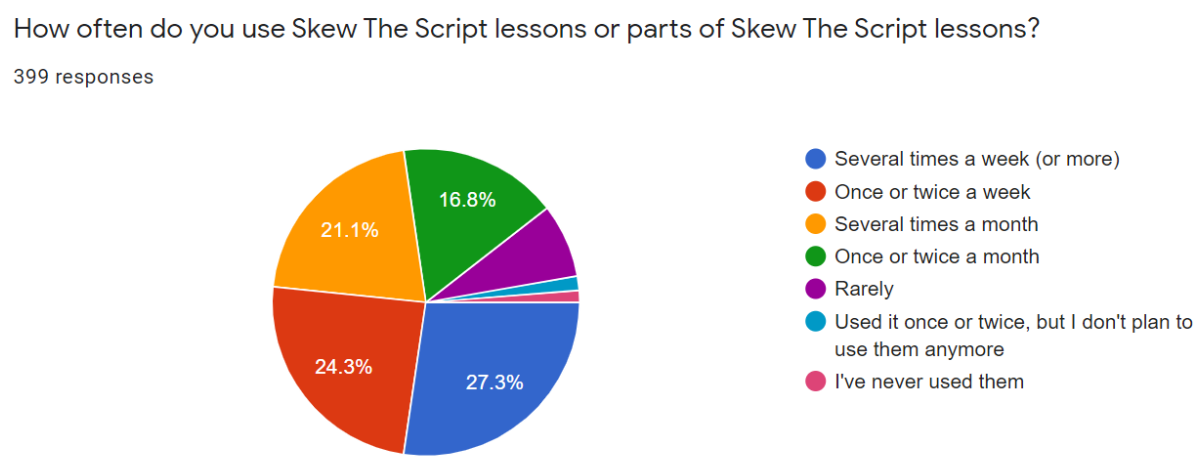
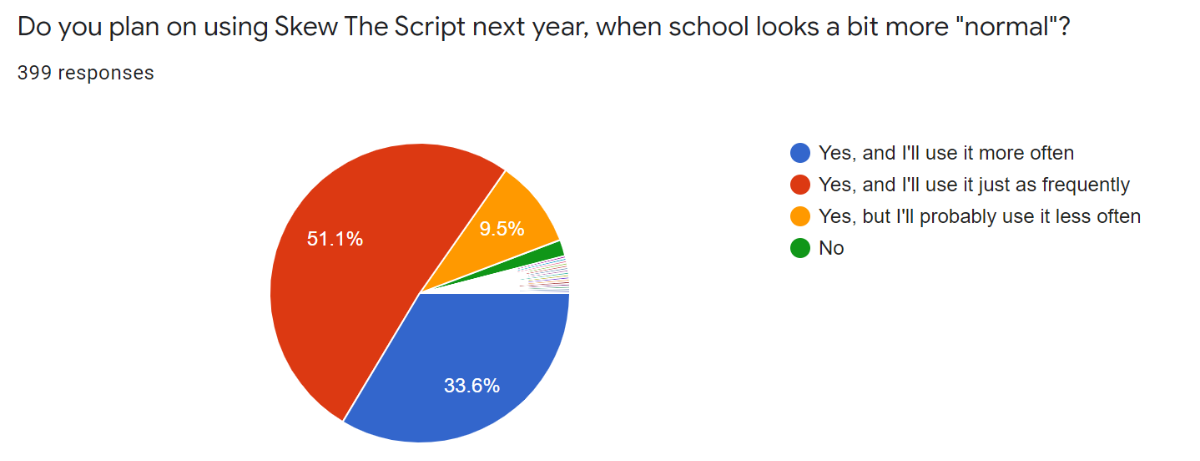
>50% of respondents use Skew The Script lessons weekly or multiple times per week. Almost 90% use our lessons at least once a month. In addition, about 94% of respondents plan to continue using Skew The Script lessons next year (under the assumption that school looks more "normal" next year). This was great to see!
2) Skew The Script Materials and Classroom Formats
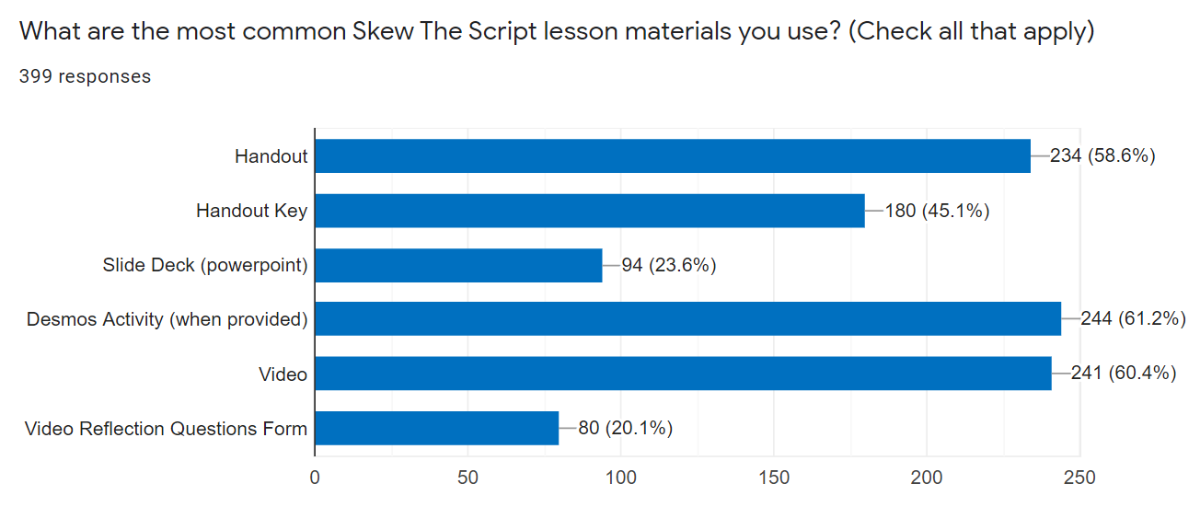
The most frequently used lesson items among respondents are the handouts, Desmos activities, and videos. Respondents do not use the slide decks and video reflection question forms as often. Interestingly, fewer people use the handout keys than the handouts. The slide decks and handout keys usually have additional background information, contexts, and notes for discussion questions - these resources may be underutilized. We'll highlight them in future emails.
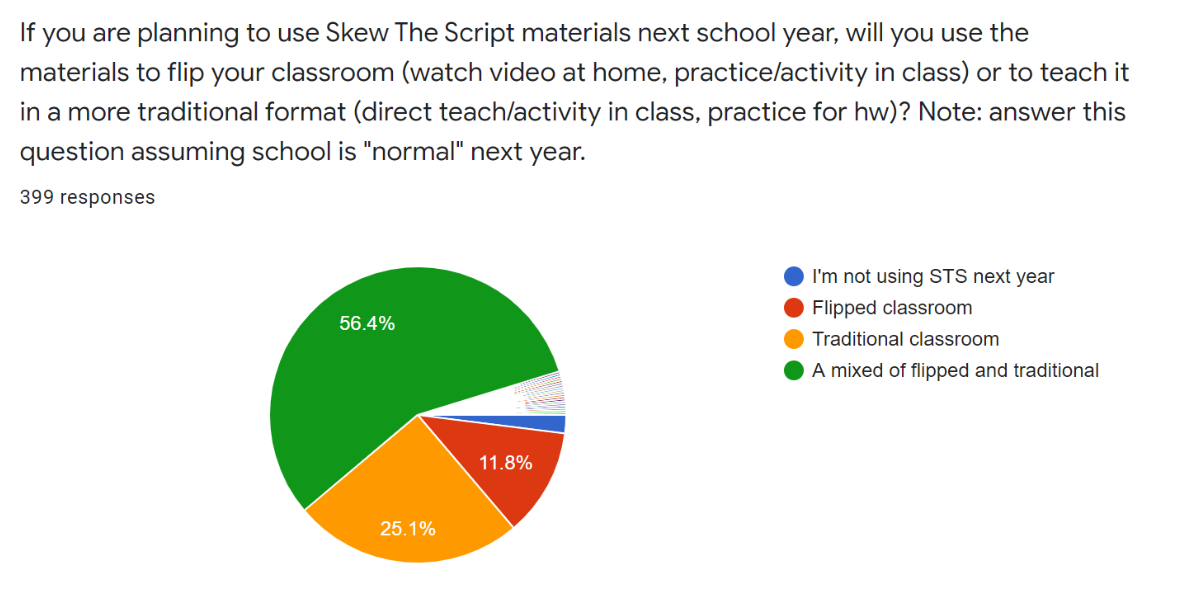
Only ~12% of respondents plan to do a fully flipped classroom next year. The majority plan to do a mix of flipped and traditional. We'll provide more information about flipping the classroom in the coming months - it's Dash's personally preferred method of teaching. However, as always, you do you! The materials are built to be flexible for multiple classroom formats.
3) Lesson Sequencing and the CED
Our current sequencing of lessons corresponds pretty well to the AP Stats CED and to most textbooks. However, we are considering changing our unit numbering to make it more perfectly align to the CED. We asked for your preference. Here were the results:
52% said we should change the lesson numbering to more closely align with the CED unit numbering.
47% said we should keep the number as is or marked that they had no preference.
1% had other suggestions.
Given the high labor cost of changing the lesson numbering - refilming videos with new numbering in slides, changing all handouts/PPTs/forms to include new numbering, changing all of our alignment guides to reflect new numbering - we only wanted to change the lesson numbering if there was a clear mandate to do so. As you can see above, there is no clear mandate.
Also, many folks left comments about how the numbering wasn't all that important to them, since our guides make alignment to the CED and to textbooks quick and easy. If you haven't already, please check out our alignment guides.
4) Adding Practice Problems
In the open-response survey questions, the most common written request was for additional practice problems and/or aligned AP Stats FRQs in the handouts and other materials.
Normally, lesson handouts end with a section that points teachers towards chapters in their textbooks, where they will find aligned practice problems to assign to students. However, while respondents say they find this helpful, they also want further practice to give to students. So, we're going to make two commitments:
At the end of every handout, we are going to add lists of past AP Exam FRQs (years & question numbers) that align to each lesson. Note: We're not allowed to reprint the FRQs themselves.
At the end of many handouts, we are going to add additional and original (AP-level) practice problems that align to the lessons.
5) Keep Contexts "Fresh"
In the open-response survey questions, the second most common request was to keep updating the Skew The Script lessons with new contexts, new datasets, and new questions as they arise. That way, the material will stay up-to-date with the most current issues and topics that engage students.
Don't worry: We’ll update our lesson materials every year. Eventually, as updates are made, many lessons will have multiple contexts to choose from - kind of like an "A, B, C" set of versions. This will give teachers even more options for engaging their students.
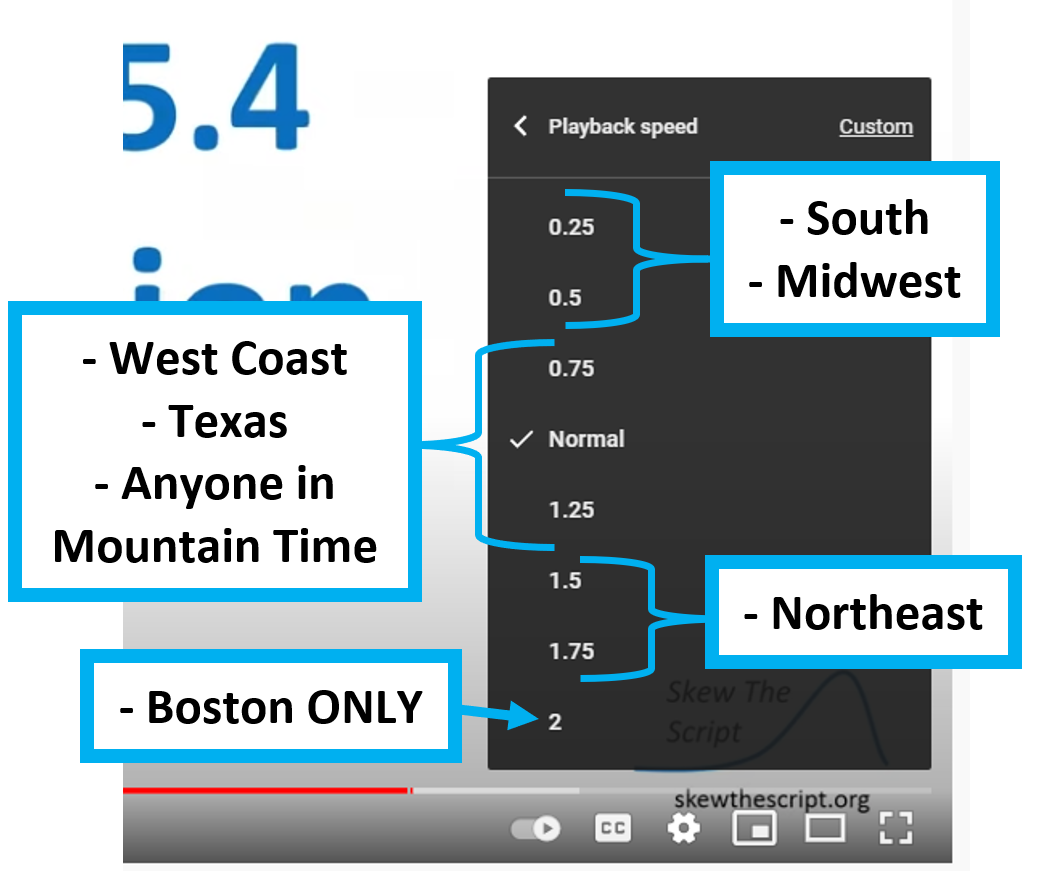
6) Dash Talks Too Fast for Midwesterners
There were several survey comments like this one: "I'm from the Midwest, and Dash talks too fast for me and my students in his videos! We have to watch on 0.75 playback speed! :)"
After Dash made a post on social media asking folks if he talked too fast for everyone, he received a variety of responses - and a lot of variety based on regional cultural difference in talking speeds. He compiled this feedback together and made the following guidance on using YouTube's playback speed feature in different regions :)
Of course, there was a lot more feedback provided than what was shared above. Even if it wasn't mentioned here, know that we'll be addressing more feedback in the coming weeks. In the meantime, if you see a gap in our materials or an additional feature you'd like to see that hasn't appeared, please reach out. As always, we'd love to hear from you.
Let’s skew it!