
Lesson 2.5 - Privacy & Human Subject Experiments
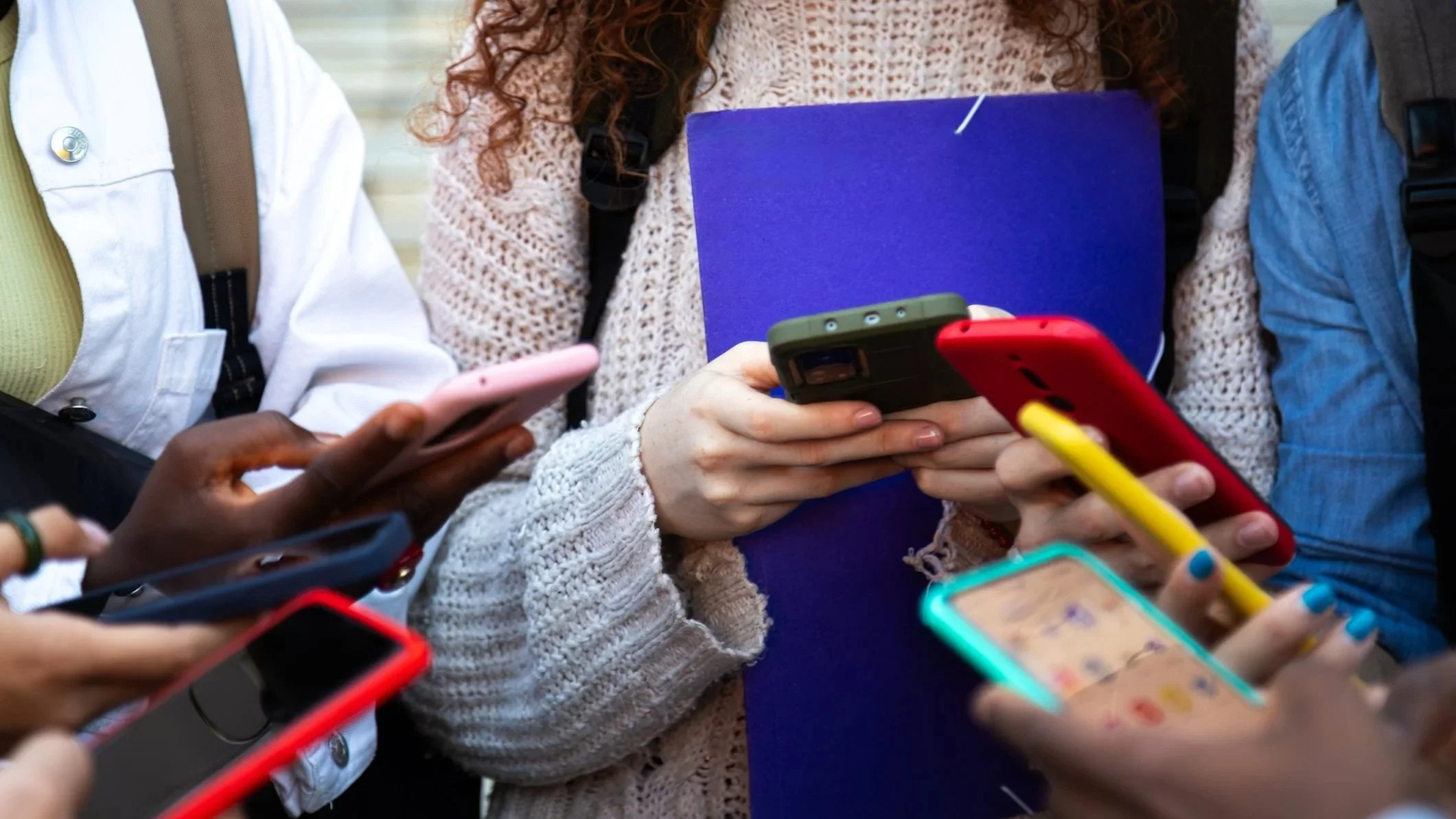
Key Question: Has social media caused declines in mental health?
Content: Placebos & Blinding | Data Privacy
Video
See the video on YouTube.
Course Resources
Resources for teaching our High School Statistics curriculum.
- Lesson Flow - timing and flow of class, using our lesson materials
- Pacing Guide - pacing our units, with daily or block schedules
- Alignment Guide - aligning our lessons to national and state standards for high school statistics
- Classroom Routines - a guidebook of classroom routines embedded within our lessons
Teaching Resources
Resources for teaching with Skew The Script.
- Discussion Norms - our model discussion norms for the classroom
- Letter to Parents - letter to share with parents about our nonpartisan approach
- Teaching Math on Civic Topics - tips for teaching math lessons that cover civic topics
Lesson Notes
Lesson-specific insights from the creators of this lesson.

Social media use has steadily declined since it peaked in 2022. In this lesson, students explore some potential reasons why. In particular, students analyze a well-designed social media experiment with some sobering results, as they investigate the relationships between social media, mental health, psychological research, and personal data privacy.
- Describe the impact of placebos and blinding
- Describe the generalizability of experimental results
- Recognize practical and ethical considerations of data privacy among human subjects.
In this lesson, students continue to develop their understanding of studies and experiments, with a particular focus on experiments involving human subjects. First, they consider how the expectation of treatment can affect human subjects – and how to counter that expectation with placebos and blinding. They also consider data privacy through the lens of personally identifiable information (PII) among human subjects. The focus of such privacy discussions in this course is to consider them from a research perspective, but students may also glean new insights about sharing (and oversharing) their personal information in other contexts (e.g. signing the terms and conditions for a new app on their phones). PII will also connect to the next lesson as a key consideration for informed consent.
Before proceeding: Familiarize yourself with the lesson materials linked above (e.g. handout, handout key, slides, video). Then, for additional background and teaching tips from the lesson creators, check out the sections below.
- We’ve found that many teenagers tend to be curious and open to having discussions about mental health and social media. However, that openness quickly closes if they feel that they’re being “given a lecturing” about social media. Starting the lesson with the examples (in the lesson slides and video) of past concerns about radio, television, and video games provides a helpful “we know some concerns have been overblown in the past” framing to the lesson. Then, presenting the more recent statistics about mental health declines feels less like a lecture, and more like the presentation of a compelling question: are these trends just associated with the spread of social media, or are they causally connected?
- Many students are frequent social media users. Bringing that expertise into the room can feel empowering, and we find that students are often excited to dive into this lesson and share their own experiences. At the same time, other students may not feel as comfortable discussing their own experience with social media, especially as it relates to mental health. We recommend keeping this lesson’s discussions at the statistical level, while also allowing students to share their own experiences according to their own level of comfort.
- In the Lesson 2.4 Synthesis, students were asked to consider an experiment they would like to conduct. At that time, they considered one or more principles of experimental design. To personalize students’ consideration of placebos, ask several students to share their experimental topic from that prior reflection and identify whether they think their study should include a placebo and why.
First, download this lesson's slide deck and handout key to see the prompt and sample responses for the Lesson Starter. Then, check out the additional background notes below.
Instructional routine: Same or Different. This Same or Different protocol uses the more traditional structure of comparing and contrasting two items. Students should list similarities on one side of the T-frame and differences on the other.
Purpose & Background: The goal of this lesson starter is for students to consider two highly correlated variables that are, in fact, completely unrelated – and that correlation does not necessarily imply a causal relationship. This can then naturally lead into the lesson's focus on social media and mental health. Mental health metrics declined during the same years that social media use rose. That's a correlation. But is it causation? We need an experiment to investigate! And that's where this lesson heads.
First, download this lesson's handout key and read through its Discussion Question section. Then, check out our model discussion norms and the additional background notes below.
- To launch the discussion question, ask students to recall the last time that they shared any personal information that might be considered PII and whether those details were actually necessary for the membership or activity.
- Another perspective for this discussion question is to invite students to share their experience with a circumstance when their information may have been shared further than they expected (i.e. downloading an app led to a whole string of emails or texts). It’s best to allow voluntary response to this prompt, rather than cold calling, as not all students may be comfortable sharing about such experiences.
- Instructors can reconnect this discussion to the lesson’s focus on research by relating student contributions to a study or experiment. For example, if a student discusses sharing information with an app on their phone, this can be connected to experiments run by tech companies in which users are randomly assigned to experience two different app layouts (allowing the companies to see which layout leads to more ad clicks).
- The opening of the lesson mentions increased rates of major depressive episodes, anxiety disorders, and emergency department visits for self-harm among young people. It’s possible that the first two indicators could be attributed to more frequent detection and reporting of mental health disorders, rather than true increases in the underlying prevalence of these disorders. However, the same can’t be said about the third metric, since standards for reporting among emergency departments have not changed over the time periods mentioned in the lesson.
- Students may wonder: In the Iowa State social media experiment, why did researchers only ask participants to limit their social media use, rather than fully controlling it? In the full paper, the researchers state, “One consistent finding has been that complete abstinence from social media may not be sustainable for the average user. A less strict approach is to limit social media use by monitoring. Monitoring limited usage, as opposed to abstinence, may be more sustainable and practical.” So, researchers wanted to know if a more sustainable approach that required less coercion – merely telling folks to reduce their social media time – would still produce an effect. And it did.
- Students interested in this topic further can explore the increasing body of experimental research on social media use and mental health, including the following articles: Brailovskaia, Swarlik, Grethe, Schillack, & Margraf (2023), Davis & Goldfield (2025), Graham, Mason, Riordan, Winter, & Scarf (2021), Hunt, All, Burns, & Li (2021), Kleemans, Daalmans, Carbaat, & Anschütz (2018), Lambert, Barnstable, Minter, Cooper, & McEwan (2022), Thai, Davis, Mahboob, Perry, Adams, & Gold (2023), and Yuen, Koterba, Stasio, et al. (2019).
- It’s worth noting that, while many experiments involving human subjects would benefit from a placebo group, implementing a placebo is not always possible. For example, in the Iowa State social media experiment, the control group (the group using social media normally) did not have a placebo. Because no placebo was involved, the group that limited their own social media time may have benefited from a “placebo effect.” Namely, their expectation of improved mental health outcomes from reduced social media may have contributed to their mental health seeing true improvements. However, there’s no feasible way to give the control group in this study a placebo. So, the placebo effect is necessarily a part of the observed treatment effect.
- Although it’s not included in the lesson video, an optional brief summary of the history of data privacy legislation in the U.S. is provided in the slides. The summary discusses the following legislation:
- 1789 –The Fourth Amendment
- 1973 – Records, Computers and the Rights of Citizens
- 1974 – FERPA: Family Education rights and Privacy Act
- 1974 – Code of Fair Information Practice
- 1991 – Common Rule Human Subject Research Privacy
- 1996 – HIPAA: Health Insurance Portability and Accountability
- 2020 – CCPA: California Consumer Privacy Act (1st state of many)
Student Supports
Lesson-specific resources to support all learners.
- To support understanding of indirect identifiers, consider using “how many” questions. For example: “How many people in this class share the same gender? How many share the same height? How many share the same combination of gender, birthdate, and height?” For the last set of questions, it would be pretty rare for two students in the same classroom to share all of those same traits at once. So, this is how combinations of indirect identifiers can lead to reidentification of an individual.
- Vocabulary used in the context of the lesson may include words that are unfamiliar or have several meanings. In particular, the following mathematical terms may need clarification or a definition provided:
- Control group
- Random
- Placebo effect
- Single blind (single masked) study
- Double blind (double masked) study
- Confounding
- In addition, the following contextual terms may need clarification or a definition provided:
- Scarecrow
- Anxiety
- Depression
- FoMo (Fear of Missing Out)
- Loneliness
- Positive affect
- Negative affect