
Lesson 3.A.3 - Intro to Confidence Intervals
Key Question: How do polls account for error?
Content: Point Estimates & Margins of Error | Interpreting Confidence Intervals & Levels
Alignment: CED Topic 3.3.A
Teacher Guide
See the video on YouTube.
Course Resources
Resources for teaching our AP® Statistics curriculum.
- Lesson Flow - timing and flow of class, using our lesson materials
- Pacing Guide - pacing our units, with daily or block schedules
- CED Alignment Guide - aligning our lessons to the AP® Statistics Course and Exam Description
Teaching Resources
Resources for teaching with Skew The Script.
- Discussion Norms - our model discussion norms for the classroom
- Letter to Parents - letter to share with parents about our nonpartisan approach
- Teaching Math on Civic Topics - tips for teaching math lessons that cover civic topics
Lesson Notes
Lesson-specific insights from the creators of this lesson.
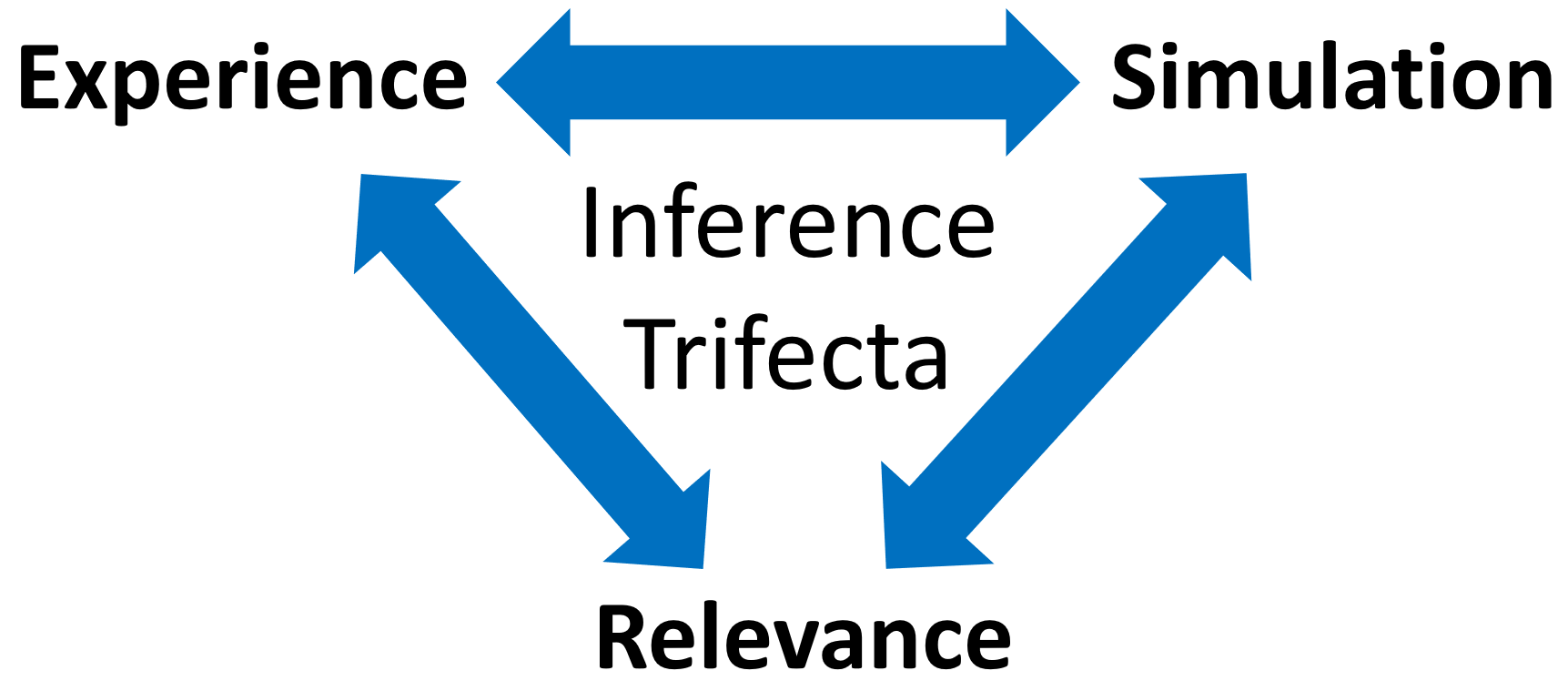
This lesson uses the inference trifecta approach, which differs from our typical lesson format. Before proceeding, watch the Teacher Guide Video above and familiarize yourself with the lesson materials (e.g. handout and key). Then, for additional background and teaching tips from the lesson creators, check out the sections below.
- Calculate a confidence interval, given a point estimate and margin of error
- Interpret a confidence interval and a confidence level
- Determine how changes in confidence level and sample size affect the width of confidence intervals
- For daily class schedules (45-min class periods), this lesson can be completed in two days:
- Day 1: Activity & Discussion Question
- Day 2: Practice & Mastery Check
- For block periods (90-minute class periods), the entire lesson can be completed in 1 class day.
- Students complete the Amplify activity (with instructors facilitating), as they record notes in their handout along the way. To facilitate an Amplify activity, instructors can create an Amplify account (also free) and share a single session code with their students (who can join without accounts).
- For facilitating the Amplify activity, we recommend using the “Sync to Me” pacing option. For more Amplify activity facilitation tips, check out our Amplify/Desmos session with expert Kevin McSorley.
- In the activity screen that allows students to generate many confidence intervals, the confidence level is adjustable after intervals are generated. However, the sample size is only adjustable before intervals are generated. So, students will have to click “try again” and create new simulations in order to adjust the sample size.
- After the notes, students discuss the Discussion Question in their tables groups. Then, students discuss in full-group, with the instructor facilitating.
First, download this lesson's Handout Key and read through its Discussion Question section. Then, check out our model discussion norms and the additional background notes below.
- The interpretation shared in the handout key’s Discussion Question section represents the frequentist perspective of statistics. In the Bayesian perspective, using the term “probability” or “chance” may be appropriate. Traditionally, the frequentist interpretation has been the preeminent view in the field, and it’s the view taken by AP Statistics and the AP Exam. However, the Bayesian view has gained some popularity in recent years, especially as computers have made Bayesian calculations easier to perform. A lot can be said about the difference between these schools of thought. Our favorite commentary is this cartoon by xkcd.
- Students may interpret a poll’s margin of error as evidence that polling organizations are uncertain or unreliable. Use this discussion to help students recognize that uncertainty is an expected and unavoidable part of sampling, even when polls are conducted well.
- The table of polls at the start of the activity comes from the 2022 Senate race between Raphael Warnock and Herschel Walker. The details of this particular race are less important than recognizing the broader pattern that different polls often produce different estimates prior to an election. This can help motivate the need for confidence intervals as a way to quantify uncertainty in sample-based estimates.
- This lesson introduces confidence intervals conceptually, but does not yet delve into the formal construction procedures (that happens in the next lesson). Still, it is helpful to reinforce the connection between confidence intervals and the shape, center, and spread of the sampling distribution of p̂. Sketches of normal curves can help students visualize how confidence intervals are built around a sample statistic.
- With this lesson, we officially begin statistical inference. “Inference” describes the practice of using sample statistics (e.g. a sample proportion) to make inferences about population parameters (e.g. a population proportion). In our course, statistical inference takes two basic forms: confidence intervals and hypothesis tests. This lesson begins students’ learning about confidence intervals. In later lessons, they will learn more about hypothesis tests.
- To help students develop intuition about confidence interval width and how it relates to confidence level, consider using a weather forecast analogy. A wide forecast range (for example, 40°F to 100°F) has a greater chance of containing the actual temperature, but is less precise and therefore less useful. A narrower range is more precise, but also more likely to miss the true value. This can help students understand the tradeoff between confidence level and interval width.
- Confidence intervals are usually written as two values (lower bound, upper bound). However, they can also be written in the form “statistic ± margin of error,” which represents the same interval structure.
Student Supports
Lesson-specific resources to support all learners.
- Reinforce that the center of a confidence interval is the sample statistic, while the width of the interval is determined by the margin of error. This distinction becomes increasingly important as students begin formally constructing and comparing intervals later in the unit.
- To clarify why larger sample sizes produce narrower confidence intervals, consider connecting this idea back to sampling distributions by emphasizing that larger samples produce less variability in p̂ from sample to sample, which leads to more precise estimates of the population parameter.
- Vocabulary used in the context of the lesson may include words that are unfamiliar or have several meanings. In particular, the following mathematical terms may need clarification or a definition provided:
- Point estimate
- Margin of error
- Lower bound
- Upper bound
- Confidence level
- Confidence interval
- In addition, the following contextual terms may need clarification or a definition provided:
- Election
- Polls
- To support students in distinguishing the term “confidence interval” from “confidence level,” encourage them to separately identify the interval endpoints, the center, the margin of error, and the confidence level before interpreting the interval in context.
- To support students in distinguishing the term “point estimate” from “sample proportion,” mention that sample proportions are a specific type of point estimate – the point estimate for a z-interval for a population proportion. As we go through the course, other statistics will serve as point estimates for confidence intervals.