
Lesson 2.A.5 - Independence & The Addition Rule
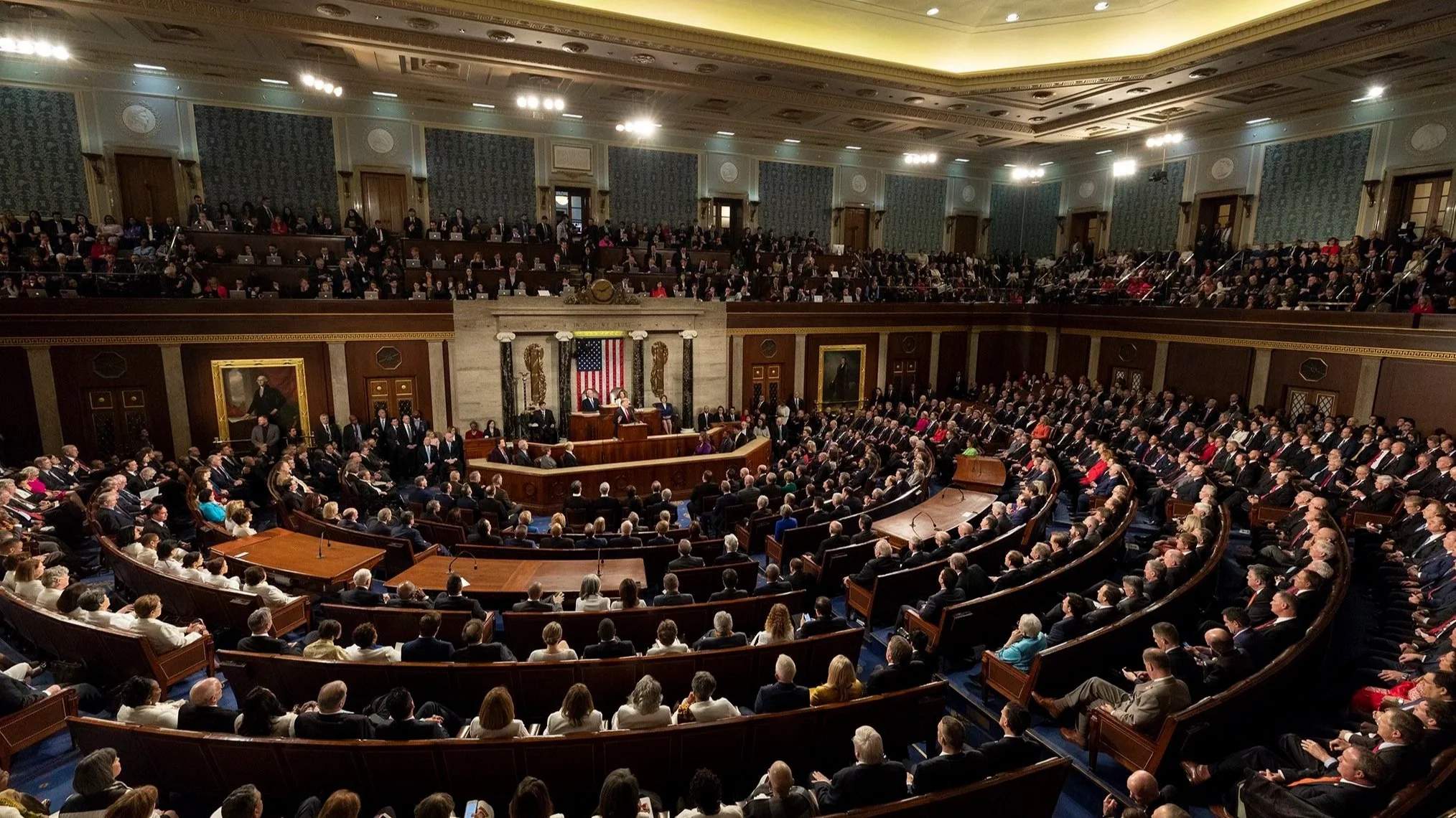
Key Question: Should Congress be allowed to trade stocks?
Content: Two-Way Tables | Independence | Addition Rule
Alignment: CED Topic 2.7
Video
See the video on YouTube.
Course Resources
Resources for teaching our AP® Statistics curriculum.
- Lesson Flow - timing and flow of class, using our lesson materials
- Pacing Guide - pacing our units, with daily or block schedules
- CED Alignment Guide - aligning our lessons to the AP® Statistics Course and Exam Description
Teaching Resources
Resources for teaching with Skew The Script.
- Discussion Norms - our model discussion norms for the classroom
- Letter to Parents - letter to share with parents about our nonpartisan approach
- Teaching Math on Civic Topics - tips for teaching math lessons that cover civic topics
Lesson Notes
Lesson-specific insights from the creators of this lesson.
Members of Congress sometimes get access to non-public information about important issues and events. This information can help them make informed decisions about legislation. However, some people have raised flags that representatives might also use this information in other ways – particularly for personal gain. In this lesson, students use the principles of probability to analyze stock trades made by members of Congress. Then, they discuss whether their representatives should be allowed to trade stocks.
- Represent data and probabilistic events with two-way tables
- Describe independence and determine whether two events are independent
- Use the addition rule to calculate probabilities
Before proceeding: Familiarize yourself with the lesson materials linked above (e.g. handout, handout key, slides, video). Then, for additional background and teaching tips from the lesson creators, check out the sections below.
- It’s important to provide a nonpartisan framing for the lesson context. The lesson materials purposefully showcase notable stock trades from representatives on both sides of the aisle. The purpose of this lesson is to analyze stock trades made by all members of Congress – regardless of party. Then, students can generate their own informed opinions about whether members of Congress should be allowed to trade stocks.
- A great way to start this lesson is by asking students what they already know about the stock market. What do they know about how stocks work? Do they know anyone who invests, or have they seen apps where people track their investments? What do they think it means to “own” a stock, and why do people buy them in the first place?
- The lesson currently proceeds in the following order: independence, two-way tables, and the addition rule. The sections on independence and two-way tables directly explore the lesson’s Key Question. So, the current ordering allows instructors to immediately address the Key Question at the beginning of the lesson. Alternatively, instructors could choose to move the section on the addition rule to the beginning of the lesson. This allows for the independence and two-way tables sections to immediately precede (and set up) the Discussion Question. Instructors can choose the ordering that best fits their ideal lesson flow.
- This lesson pulls together several of the key ideas from earlier in the unit, including conditional probability, the multiplication rule, and ways of representing the sample space. It may be helpful to remind students that these concepts are not new, but are now being connected and applied in combination. Continue to emphasize the Keys to Probability as the primary entry point for understanding; the formulas introduced here and in previous sections serve mainly to formalize and support these underlying concepts.
First, download this lesson's Handout Key and read through its Discussion Question section. Then, check out our model discussion norms and the additional background notes below.
- Under current rules, members of congress are allowed to buy and sell stocks, but they are subject to disclosure requirements and restrictions on insider trading. The STOCK Act of 2012 makes it illegal for lawmakers to use nonpublic trading information gained through their official roles for personal financial benefit. The law also requires them to publicly report trades within 45 days. This system emphasizes transparency, but still allows stock trading, which has led to ongoing debate.
- In response to these concerns, Rep. Bryan Steil (R-WI) introduced the Stop Insider Trading Act in January 2026, which would significantly tighten these rules. The proposed legislation would prohibit members of Congress and their immediate family members from purchasing individual stocks and would require advance public disclosure before selling them.
- Markwayne Mullin, who is mentioned in the lesson slides and video, was serving as a U.S. Senator from Oklahoma at the time this lesson was created. He has since left the Senate to become the U.S. Secretary of Homeland Security.
- An ideal market is fair (all investors have access to the same information) and efficient (prices adjust quickly as trades occur). In such a market, the probability of a stock gaining or losing value at any particular moment is about 50%. Why is this the case? Imagine a situation in which a stock has a much greater than 50% chance of increasing in value. Investors would recognize this opportunity and quickly begin buying the stock. As demand increases, the price would rise. This process would continue until the price reaches a level where the advantage disappears, bringing the probability of future gains back toward 50%. In this way, buying and selling activity continuously pushes prices toward a short-term equilibrium.
- Although the short-term probability of a stock increasing in value is about 50%, the long-term probability is somewhat higher. This is because the stock market as a whole tends to increase in value over time. The trades discussed in this lesson take place over a period of months, so we might expect the probability of a stock gaining value to be slightly above 50%. However, as shown in the lesson, Congressional representatives not only had more than a 50% chance of buying stocks that increased in value. They also had more than a 50% chance of selling stocks that decreased in value. Even in a setting where gains are somewhat more likely than losses, this combination of outcomes is notable.
- When combined with conditional probability, the addition rule can be used to derive the Law of Total Probability – a fundamental law in probability theory (outside the scope of this course). The Law of Total Probability enables the application of Bayes’ Theorem and Bayesian Statistics to a variety of probabilistic / statistical scenarios. Both Bayes’ Theorem and Bayesian Statistics are also outside the scope of this course. That said, as an enrichment activity, a high school-level exploration of these concepts can be found here.
- In the next unit, students will be introduced to binomial probability distributions, where independence is one of the key conditions that must be satisfied. The distinction between sampling with replacement and without replacement, and its connection to independence, is especially important in the binomial setting. This lesson lays the groundwork for that idea.
- Later in the course, independence will also become an important condition for statistical inference. In particular, students will revisit this idea when working with the 10% condition, which helps justify treating observations as effectively independent.
Student Supports
Lesson-specific resources to support all learners.
- Among all the Keys to Probability, the one that best supports students in getting started with probability problems is “Draw it First.” For the practice exercises that don’t already include a two-way table or Venn diagram, encouraging students to draw one can help them organize the information and organize their thinking.
- Students often confuse “mutually exclusive” with “independent,” so it can be helpful to use Venn diagrams to make the distinction visible. Draw two circles with no intersection to represent mutually exclusive events. Then, point out that if one event occurs, the other cannot happen, meaning the occurrence of one directly affects the probability of the other. So, mutually exclusive events cannot be independent, since knowing one event has occurred gives you complete information about the other.
- It can also be helpful to highlight the connection between independence and conditional probability. Conditional probability measures how one event affects another; independence means there is no effect. Students might explore this using a tree diagram, as demonstrated in the slides for lesson 2.A.4, by tracing branches for two events and focusing on the probabilities along the second set of branches. For independent events, they should notice that these probabilities stay the same, regardless of the outcome of the first event. Then contrast this with dependent events, where the probabilities along the second branches change depending on what happened first.
- Vocabulary used in the context of the lesson may include words that are unfamiliar or have several meanings. In particular, the following mathematical terms may need clarification or a definition provided:
- Independence
- With / without replacement
- Addition rule
- In addition, the following contextual terms may need clarification or a definition provided:
- Stock
- Investment
- Committee